
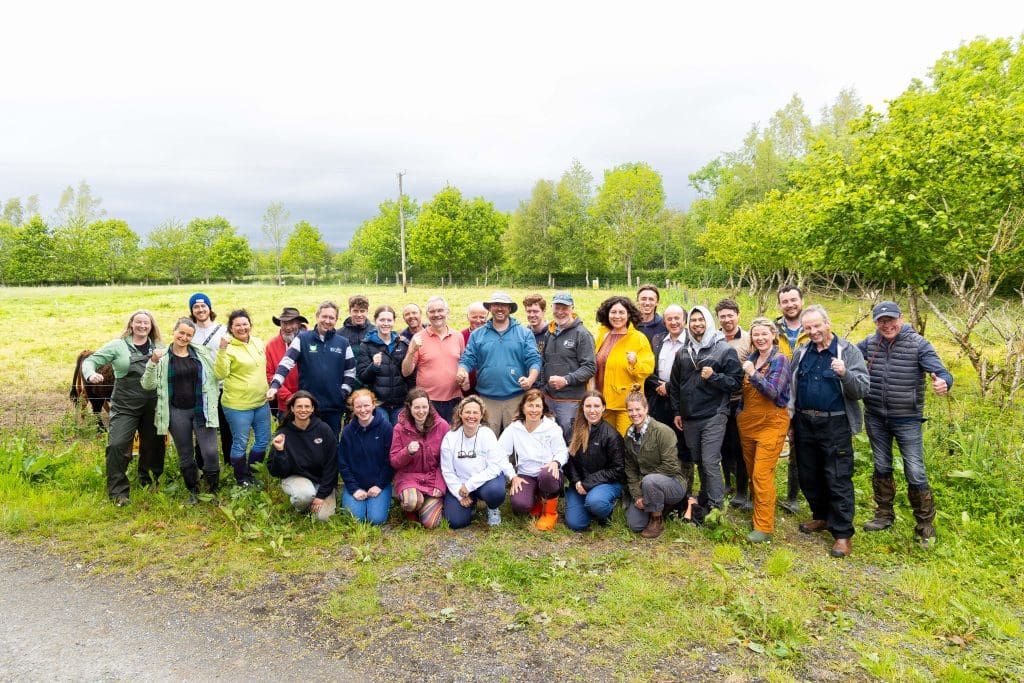
20 farms participating across the country
A major new farmer-led initiative exploring how regenerative farming practices perform in Irish conditions is now underway across 20 farms nationwide, with international experts working directly with participating farmers.
Regen Ireland, a European Innovative Partnership Project, co funded by the EU and the Department of Agriculture Food and the Marine has launched a four and half year regenerative farming initiative involving dairy, beef, sheep and tillage farms across Ireland, bringing together farmers, international expertise and on-farm monitoring to help build a stronger evidence base around regenerative agriculture in an Irish context.
Minister for Agriculture, Food and the Marine, Martin Heydon said:
“I am delighted to see Regen Ireland bringing a collaborative group together to promote the benefits of regenerative agriculture in Ireland. I am confident that, through the engagement of all the participant farmers over a wide geographical area, the project will yield high quality and impactful results. I would like to extend a warm welcome to Dr. Jonathan Lundgren and his team who are visiting the participating farmers in the Regen Ireland project, supported by my Department under the European Innovation Partnership (EIP) programme. I wish Regen Ireland together with their project partners every success over the next number of years.”
Regenerative farming is an approach to agriculture focused on improving soil health, increasing biodiversity and strengthening the natural resilience of farming systems. Internationally, regenerative approaches are attracting growing attention for their potential to support healthier soils, improve water retention and reduce reliance on costly external inputs such as synthetic fertilisers and chemicals – a particularly relevant topic currently due to the impact of the Straits of Hormuz crisis on fertiliser supplies and prices – which could potentially impact food production and security down the line.
The Regen Ireland project will explore how these approaches may perform under Irish farming conditions, including their potential impact on areas such as soil health, biodiversity, water infiltration, farm resilience and long-term farm economics and sustainability. The 20 participating farms are geographically spread across the county with representatives in Carlow, Cork, Galway, Kerry, Kilkenny, Laois, Limerick, Meath, Tipperary, Roscommon, West Meath, Waterford and Wexford
The project’s initial advisory phase has involved on-farm consultations with regenerative agriculture specialists from Understanding Ag, with participating farmers receiving tailored guidance and recommendations from recognised regenerative agriculture experts including Gabe Brown and Dr. Allen Williams, to help inform the practices they will trial over the coming years.
As part of the project’s next phase, internationally recognised scientist, regenerative farmer and Ecdysis Foundation founder Dr. Jonathan Lundgren and his team are now visiting participating Irish farms to help roll out the project’s baseline monitoring and assessment programme.
Dr Jonathan Lundgren is an agroecologist, entomologist and farmer based in South Dakota, USA. Formerly a top research scientist with the USDA, he received the Presidential Early Career Award for Science and Engineering from the White House and has served as an advisor for national grant panels and regulatory agencies on pesticide and GM crop risk assessments. Dr Lundgren left government service to pursue independent, farmer driven science, establishing the Ecdysis Foundation to ‘Serve as a scientific voice to support the evolution of a regenerative food system through research, demonstration and education’. He has authored 107 peer-reviewed journal articles.
The monitoring process will play a central role in the project, helping participating farmers gather observations and data over time to better understand how regenerative approaches may perform under Irish farming conditions. This science will be a key part in supporting the trials on the project’s 20 farms.
Regen Ireland is also exploring opportunities to connect with wider international regenerative agriculture monitoring initiatives and collaborative learning networks.
Speaking during the visit, Sean Butler, a member of the Regen Ireland Operational Group and farm mentor, said:
“Farmers across Ireland are under increasing pressure from rising input costs – particularly fertiliser – changing weather patterns and uncertainty about the future. One of the key questions this project hopes to explore is whether regenerative approaches can help farmers build more resilient and economically sustainable systems over the long term.”
“What makes this initiative important is that it is happening on real working farms in Irish conditions. The farmers involved are learning directly through observation, monitoring and practical experience, and over time we hope that shared learning can help other farmers who may be interested in exploring similar approaches.”
Dr. Jonathan Lundgren, Founder of the Ecdysis Foundation, said:
“Around the world, there is growing interest in how regenerative farming practices may contribute to healthier soils, stronger biodiversity and more resilient agricultural systems. But farming systems are shaped by local environmental conditions, which is why projects like this are so important.”
“By combining farmer participation with long-term monitoring and observation, this initiative has the potential to generate meaningful insights into how regenerative approaches may function within Irish farming landscapes and environments.”
Over the course of the four-and-a-half-year initiative, participating farms will take part in ongoing monitoring, workshops and knowledge-sharing activities designed to support practical learning and develop a stronger understanding of regenerative farming approaches within Ireland. Participating farmers will also receive ongoing support from mentors and fellow participants throughout the four-year initiative.
The Regen Ireland project is co-funded through the European Innovation Partnership (EIP) programme, which supports collaborative and innovative approaches linked to sustainable agriculture and environmental resilience, as well as the Department of Agriculture, Food and the Marine under the Common Agricultural Policy Strategic Plan. Partners (to date) include NOTs, University College Cork, Munster Technological University, Ecdysis, and Understanding Ag.
Further information and project updates will be available at https://regenireland.ie/